Window Treatment in Pearson and White & Morris Additions, Sheridan
Custom Sheridan window treatment crews serving Pearson and White & Morris Additions homeowners with free in-home measure, repair, replacement.
Questions from this neighborhood in Sheridan, where a good share of the work is updating what a builder originally installed. The answers cover what to keep, what to service and what to replace.
- Services: faux wood blinds, wood blinds, vertical blinds, aluminum mini blinds
- Service area: Pearson and White & Morris Additions, Sheridan, IN and surrounding areas We schedule measures promptly and we're honest about what comes after. Your product is manufactured to your dimensions, which takes weeks rather than days, and that applies to every custom line we sell.
- Insured and bonded
- Serving Sheridan, IN since 2008
Local Window Treatment Experience in Pearson and White & Morris Additions
A Pearson measure is the hardest inside mount in Sheridan, and it is hard for the opposite reason to the one downtown. The historic core gives you deep, irregular, storm panel choked openings. Pearson gives you almost no depth at all: narrow wood jambs on the 1950s and 1960s houses, and aluminum frames on the 1970s parcels that leave barely a flat surface to land a bracket on. A ranch of this era runs 10 to 15 openings and nearly every one of them sits at the same sill height, which is the one thing that makes the job easier. Consistency is real here. Depth is not.</p><p style="font-size:16px;color:#4a5a6a;line-height:1.75;margin:16px 0 0">The other defining unit is the wide front picture window, usually with a narrow operable unit on each side. That single opening drives more of the quote than the rest of the house put together, because width is where a roller tube deflects, where a headrail needs a center support bracket, and where a one piece shade starts to feel heavy on a cord lock. Pearson's nine houses went up between 1952 and 1981, so most of these front rooms have been taking Indiana afternoons for 45 to 75 years. On a cardinal grid where 2nd through 6th run one way, roughly a quarter of them face full west.
We have served Pearson and White & Morris Additions homeowners through the full range of window treatment needs, from inspections and repairs to full replacements. Whatever the system, our Sheridan crew approaches every project with clear communication and respect for your property.
Pearson and White & Morris: 20 parcels, 104 years apart
The counts are small and the spread is not. Pearson returns nine built parcels with years running 1952 to 1981, roughly thirty years of building on one plat. White & Morris returns 11 with years running 1900 to 2004. Nothing else in Sheridan runs that long under one name. The practical consequence is that the plat label tells you nothing on its own: a White & Morris address might be a frame vernacular house from the gas boom era or a production house finished in 2004, and those two get different mounts, different frames and different products. Builder identity is not sourced for either plat, and neither is lot size or floor area, so we take those on site.
Sheridan's mid century block is genuinely small. The ACS puts 23 units in the 1940s, 151 in the 1950s, 35 in the 1960s and 32 in the 1970s, 241 in total across four decades, against 477 units built before 1940 and 527 built from 2000 to 2019. The Hamilton County parcel layer counts the same decades slightly differently at 22, 35, 47 and 94, and both figures are reported rather than reconciled. Either way, Pearson is a meaningful share of a very small population of houses. No separate price band is published for either plat: the town median sale price of $334,900 is driven by the newer stock at the other end of town.
What a Pearson and White & Morris measure runs into
Depth decides the product list here and there is not much of it. A 1950s narrow wood jamb may give you enough flat surface for a slim headrail and nothing more, and a 1970s aluminum frame often gives less than that. So the first decision on nearly every opening is flush mount, partial recess or outside mount, and we make it opening by opening rather than room by room. A factory deduction of 1/16 inch per side is unforgiving in a shallow mount: it is the difference between a shade that clears and a shade whose bottom rail rubs the frame on the way down. Where depth fails, the narrow casing on these houses still gives a bracket something to bite, unlike the flat drywall returns out in the newer subdivisions.
Then width, which is the Pearson signature. A wide picture window flanked by narrow operable units is one opening in three parts, and treating it as one shade is often the wrong call. A single roller wide enough to cover the whole thing will deflect in the middle of the tube unless we add a center support bracket, and that support then interrupts the fabric in your sightline. Two or three shades on a shared headrail keeps the top line and loses the deflection. On top of that, 45 to 75 years of settlement makes out of square likely, and on the 1970s aluminum units the frame itself may be racked independently of the opening around it. We measure both.
The shallowest jambs in Sheridan
Pearson's 1950s and 1960s houses have narrow wood jambs, and the 1970s parcels carry aluminum frames with very little flat surface at the head. This is the hardest inside mount condition in town, and it fails in the opposite direction to the 1900s stock downtown, which is deep but irregular. We take a depth reading at the head of every opening and tell you before you choose fabric which ones can take a recessed headrail and which cannot.
One picture window, three different decisions
The wide front unit with a narrow operable unit on either side is the defining opening in Pearson. Cover it as one shade and you need a center support bracket to stop the roller tube deflecting, and that support sits in the middle of your view. Cover it as three on a shared headrail and you keep a clean line at the top with two vertical breaks in the fabric. Neither is wrong. We show you both before ordering.
Out of square in the opening and in the frame
Forty five to seventy five years of settlement makes an out of square opening likely on any of these 20 parcels. On the 1970s aluminum units there is a second problem stacked on the first: the frame itself may have racked independently of the wall around it. A shade ordered against a single center reading will bind at one end. Three width readings, three height readings, order to the smallest, and we say up front where a light gap will show.
Same sill height everywhere, which is worth money
A 10 to 15 opening ranch on the Pearson plat puts nearly every window at one sill height, mostly on a single story. That is the one thing this stock makes easy. It means a consistent bottom rail line across a room, no ladder work over a stairwell, and no stack height argument about two story foyer glass. The house is straightforward to install once the depth question at each opening has been settled.
What we specify most in Pearson and White & Morris
The product list here is short and it is driven by shallow depth and one wide opening. Anything needing a deep recess is out, anything spanning that much width needs support engineering, and anything that would have to fit an out of square 1970s aluminum frame gets mounted over it instead of inside it. There is also a solar control argument in this stock that does not apply in the historic core: a wide west facing picture window on a single story ranch is the biggest single heat gain in the house, and Indianapolis runs a July average high of 85.2F with muggy weather from 25 May to 22 September. National ranges only: custom work $250 to $2,600 per window, stock shades $60 to $600, awnings $1,000 to $6,000 installed.
Faux wood blinds
The default answer on the Pearson ranch stock and the practical one. Mounted outside on the narrow casing where the jamb is too shallow to recess a headrail, they cover the opening completely and hide the out of square along with it. Faux wood holds its shape in a kitchen or a bath where real wood cups, which matters through an Indiana muggy season running 25 May to 22 September. Two inch slats close tighter than one inch and read correctly on a 1950s house.
Roller shades
Specified for the wide front picture window, and specified carefully. Past a certain width the tube deflects and needs a center support bracket, so we will usually split the opening into two or three shades on one headrail instead, keeping the top line continuous. Choose roll direction before the cassette: a reverse roll clears a deep sill or a crank handle but will not work behind a fascia, and on these shallow 1970s frames that clearance question is real.
Aluminum blinds
Worth naming because on a 1970s aluminum horizontal sliding unit in Pearson there may be nothing else that will physically inside mount. A one inch aluminum blind needs less depth than almost anything on the list and can sit inside a frame that will not take a cellular headrail or a shutter frame. It is a narrow use, we specify it where the depth reading says so, and it suits the flanking units beside a picture window rather than a whole house.
Exterior solar shades
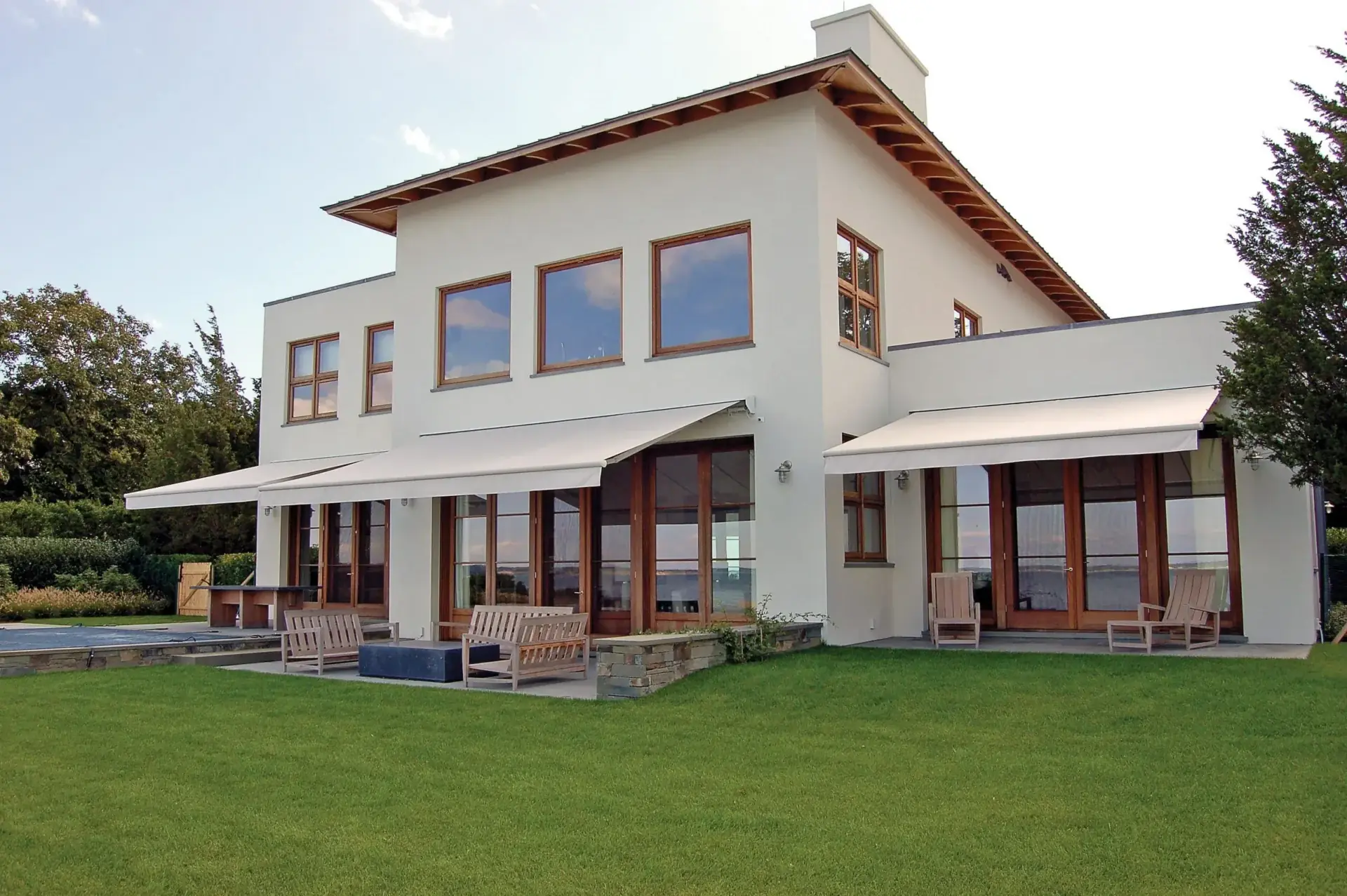
A wide picture window facing west on Sheridan's cardinal grid takes the whole afternoon, and stopping heat outside the glass beats fighting it inside. Exterior solar shades on a track cut gain before it enters the room and you can still see out. Retractable awnings do the same over a patio door at $1,000 to $6,000 installed nationally. NFRC attributes 40 to 60 percent of fading damage to UV, so this slows fade on your floor rather than stopping it.
Pearson, White & Morris and the Sheridan grid
The county's street name field returned nothing for either plat, so there are no streets listed here: it came back populated for Maple Run, Atwater and the Higbee plats only. Neither plat carries a named landmark of its own either. What they do carry is position inside Sheridan's original cardinal grid, where the numbered streets 2nd through 6th run one way and Main, Georgia, Ohio and Adams run the other, which pins every front elevation to one of four directions. Schools are Sheridan Community Schools, the only small corporation among the Hamilton County towns in this project. The 1912 Carnegie library, Biddle Memorial Park and the State Road 47 and 38 crossing all sit inside 2.14 square miles.
Window Treatment Services in Pearson and White & Morris Additions
Every service Sheridan Window Treatments offers across Sheridan is available to Pearson and White & Morris Additions homeowners.
Faux Wood Blinds in Pearson and White & Morris Additions
Moisture proof slats for Sheridan's baths and back kitchens
Learn more →Wood Blinds in Pearson and White & Morris Additions
Basswood for the 477 houses Sheridan built before 1940
Learn more →Vertical Blinds in Pearson and White & Morris Additions
Honest coverage for Sheridan's newest sliding doors
Learn more →Aluminum Mini Blinds in Pearson and White & Morris Additions
The shallow jamb fix for Sheridan's mid century openings
Learn more →Roller Shades in Pearson and White & Morris Additions
Clean fabric on a tube, with the gaps published upfront
Learn more →Solar Shades in Pearson and White & Morris Additions
Glare control sized to Sheridan's cardinal grid west sun
Learn more →Cellular Shades in Pearson and White & Morris Additions
The only shade with Department of Energy test numbers behind it
Learn more →Zebra Shades in Pearson and White & Morris Additions
One fabric, two settings, and no blackout promises
Learn more →Roman Shades in Pearson and White & Morris Additions
Soft folds for the tall openings of the 1866 plat
Learn more →Woven Wood Shades in Pearson and White & Morris Additions
Natural texture, with its variation disclosed first
Learn more →Blackout Shades in Pearson and White & Morris Additions
Dark rooms need channels, not just dark fabric
Learn more →Plantation Shutters in Pearson and White & Morris Additions
Rigid panels engineered for Sheridan's least rigid openings
Learn more →Cafe Shutters in Pearson and White & Morris Additions
Privacy at eye level on Sheridan's close set town lots
Learn more →Motorized Shades in Pearson and White & Morris Additions
Automation limited to the glass you can't reach
Learn more →Custom Drapery in Pearson and White & Morris Additions
Panels sized by fullness, hemmed after the fabric settles
Learn more →Valances & Top Treatments in Pearson and White & Morris Additions
Decoration sold as decoration, never as light control
Learn more →Exterior Solar Shades in Pearson and White & Morris Additions
Stop the heat outside the glass, then retract it
Learn more →Retractable Awnings in Pearson and White & Morris Additions
Shade for the patio, retracted before the weather
Learn more →Commercial Window Treatments in Pearson and White & Morris Additions
One elevation, one order, one dye lot
Learn more →Skylight Shades in Pearson and White & Morris Additions
Overhead glass covered, then reached without a ladder
Learn more →Sliding Glass Door Blinds in Pearson and White & Morris Additions
Stack parked off the panel you actually use
Learn more →Panel Track Blinds in Pearson and White & Morris Additions
Wide glass in flat panels, stacked to the side you choose
Learn more →Sheer Shades in Pearson and White & Morris Additions
Tilting fabric vanes that filter light without darkening a room
Learn more →Pleated Shades in Pearson and White & Morris Additions
The value shade, sold with its one real limitation stated
Learn more →Bamboo Shades in Pearson and White & Morris Additions
Natural weave, honest about how much light gets through
Learn more →Dual Shades in Pearson and White & Morris Additions
Two fabrics, one opening, and a level line required
Learn more →Top-Down Bottom-Up Shades in Pearson and White & Morris Additions
Light from the top, privacy down at the sidewalk
Learn more →Cordless Blinds in Pearson and White & Morris Additions
No hanging cord, and a spring that ages honestly
Learn more →Hardwood Shutters in Pearson and White & Morris Additions
Real wood where the trim is stained, and nowhere humid
Learn more →Composite Shutters in Pearson and White & Morris Additions
Heavier panels, engineered for Sheridan's widest openings
Learn more →Smart Home Shade Integration in Pearson and White & Morris Additions
Radio planning first, then shades, then the hub question
Learn more →Blind Repair & Restring in Pearson and White & Morris Additions
Fixed where it's fixable, said plainly when it isn't
Learn more →Shutter Repair in Pearson and White & Morris Additions
Hinges and louvers fixed, panel matching confirmed first
Learn more →Motorization Retrofit in Pearson and White & Morris Additions
Motors added to existing shades, where the headrail allows
Learn more →Outdoor Patio Shades in Pearson and White & Morris Additions
Anchored into structure, because wind is the failure mode
Learn more →Office Window Treatments in Pearson and White & Morris Additions
Glare, reach compliance and one specification per elevation
Learn more →Healthcare Window Treatments in Pearson and White & Morris Additions
Cleanable, cordless, and documented in the submittal package
Learn more →Multifamily Window Treatments in Pearson and White & Morris Additions
One specification per floor plan, ordered a phase at a time
Learn more →Driving Distance From Sheridan
Pearson and White & Morris Additions is one of several Sheridan communities we serve. We measure and install across Sheridan, Hamilton County, and surrounding areas.
Pearson and White & Morris Additions Window Treatment FAQ
Questions we hear most often from Pearson and White & Morris Additions homeowners.
Free Assessment in Pearson and White & Morris Additions
Schedule a free, no-obligation window covering inspection. We respond promptly to all Pearson and White & Morris Additions inquiries.