Window Treatment Serving Sheridan Downtown Commercial Historic District
Custom Sheridan window treatment crews serving Sheridan Downtown Commercial Historic District homeowners with free in-home measure, repair, replacement.
Questions from this neighborhood in Sheridan, where a good share of the work is updating what a builder originally installed. The answers cover what to keep, what to service and what to replace.
- Services: faux wood blinds, wood blinds, vertical blinds, aluminum mini blinds
- Service area: Sheridan Downtown Commercial Historic District, Sheridan, IN and surrounding areas We schedule measures promptly and we're honest about what comes after. Your product is manufactured to your dimensions, which takes weeks rather than days, and that applies to every custom line we sell.
- Insured and bonded
- Serving Sheridan, IN since 2008
Local Window Treatment Experience in Sheridan Downtown Commercial Historic District
One building downtown gives you two opposite mounting problems, and you'll meet both before you reach the stairs. The storefront frame at grade is shallow, with almost no flat surface to hold a bracket, so a shade there is an outside mount on the header or on the transom band. Go up one floor and the masonry reveals are the deepest inside mount condition in Sheridan, deeper than anything in Maple Run or on the Higbee plats. That's a genuine inside mount with room for a 2 inch louver. Same address, same afternoon, two specifications. We write them as separate lines on one order.</p><p style="font-size:16px;color:#4a5a6a;line-height:1.75;margin:16px 0 0">The exposure question here has a cleaner answer than anywhere else in town. Main Street runs north south through the district, from East 2nd Street down to the Old Monon right of way, so the two commercial faces are east and west elevations. One whole side of Main Street takes direct afternoon sun onto its display glass every day and the side opposite gets morning light and nothing more. In a July averaging an 85.2F high in Indianapolis, that's a real difference in cooling load and in what happens to goods sitting in the window. We quote by side of the street, not by building.
We have served Sheridan Downtown Commercial Historic District homeowners through the full range of window treatment needs, from inspections and repairs to full replacements. Whatever the system, our Sheridan crew approaches every project with clear communication and respect for your property.
38 contributing buildings from about 1880 to 1939
This is commercial and civic stock, not houses. The National Register nomination counts 38 contributing buildings and 1 contributing structure, two and three stories, with ground floor storefronts and upper floor space serving as offices, apartments or storage rather than as detached dwellings. Lots are zero lot line, built to the Main Street sidewalk, so there's no setback and no residential price band published for the district. No single developer built it either. Individual merchants did, H.J. Thistlethwaite and the Stanley Brothers among them, over roughly sixty years, which is why an Italianate front sits next to a Romanesque Revival one instead of a repeated elevation.
Upper floor unit sizes for the district aren't published anywhere we could reach, so square footage downtown gets measured rather than quoted. What is sourced is the period, about 1880 to 1939, and the two styles the nomination names. That range puts these buildings between 87 and 146 years old. In practice the difference between the 1914 bank building and the 1886 opera house block shows up in head height and in how much reveal you get above the storefront. Sheridan's whole footprint is 2.14 square miles and this district is a few blocks of it, so the entire commercial inventory can be walked in an afternoon.
Storefront glass at grade, deep masonry reveals above
Figure 6 to 16 upper floor openings per block on the street elevation, plus a full width display bay at grade with a transom band over it. That count is inference from the sourced building types rather than a survey. The shapes are era specific and they change the order: round arched Romanesque Revival heads and segmental Italianate heads on the upper floors, tall narrow upper floor openings with heads well above 80 inches, and a storefront transom band that is its own separate treatment. The Thistlethwaite Building carried an opera house and a lodge room, so its upper floors have assembly room openings rather than domestic ones, and they sit well beyond reach from the floor.
Then there's the age problem. Masonry openings between 87 and 146 years old measure differently at head and sill, and nothing repeats across a facade, let alone between buildings that went up decades apart. We measure three points each way and record head shape per opening, because a round arched head is a different order line from a rectangle. At grade the constraint flips from squareness to depth: the display frame gives almost nothing to mount into, and a shade over a bay 10 feet wide or more is a long roller that needs a center support bracket and a tube sized for the span.
The west side of Main Street, every afternoon
Main Street runs north south through the district, so one commercial face takes the full west load onto its display glass and the face opposite never does. That's the sharpest exposure split in Sheridan and it changes the fabric, not just the color. We spec 3 percent openness on the west storefronts and 5 percent across the street. NFRC attributes 40 to 60 percent of fading to UV, so a solar fabric slows what happens to displayed goods rather than ending it.
A storefront frame has nowhere to hold a bracket
The display frame at grade on Main Street is shallow, and an inside mount usually isn't on the table. The shade fixes outside the opening, onto the header or the transom band, with real overlap at each side. One detail catches people out: a reverse roll won't work behind a fascia, so if you want fabric hanging close to the glass you're choosing between the fascia and the roll direction. We settle that at the measure, not after fabrication.
The deepest reveals in town are upstairs
Masonry walls on the upper floors give more usable mounting depth than any drywall return in Maple Run or Sheridan Estates. A 2 inch wood blind or a Z-frame shutter sits fully inside the reveal and reads flush. The factory deduction is still 1/16 inch per side, so a light gap remains, and on an opening with a head above 80 inches it runs a long way down. Where a tenant needs the room dark we add a light blocking pocket at the head.
Assembly room openings you can't reach
The 1886 Thistlethwaite Building carried an opera house and a lodge room, and openings on that floor are scaled to a hall rather than a bedroom. Anything at that height gets motorized or it gets left alone. Hunter Douglas states PowerView battery life is about one year, which on a head that high means a ladder every year unless the run is hardwired. We'd rather write the hardwired option into the quote than surprise you in month thirteen.
What we specify for a building on Main Street
A Main Street building downtown is two jobs at one address: a display level that sells with light, and upper floors that need privacy after dark. We price them separately because the products are different. Pricing comes from national ranges, since no published window treatment pricing for Sheridan exists: custom treatments $250 to $2,600 per window, shutters $175 to $800, motorized $300 to $1,500 per window installed, retractable awnings $1,000 to $6,000 installed. Custom fabrication runs 2 to 5 weeks. On residential work over $150 the Indiana Home Improvement Contract Act (IC 24-5-11) requires a written contract stating scope, dates and total price, and we're insured and insured on the commercial work as well.
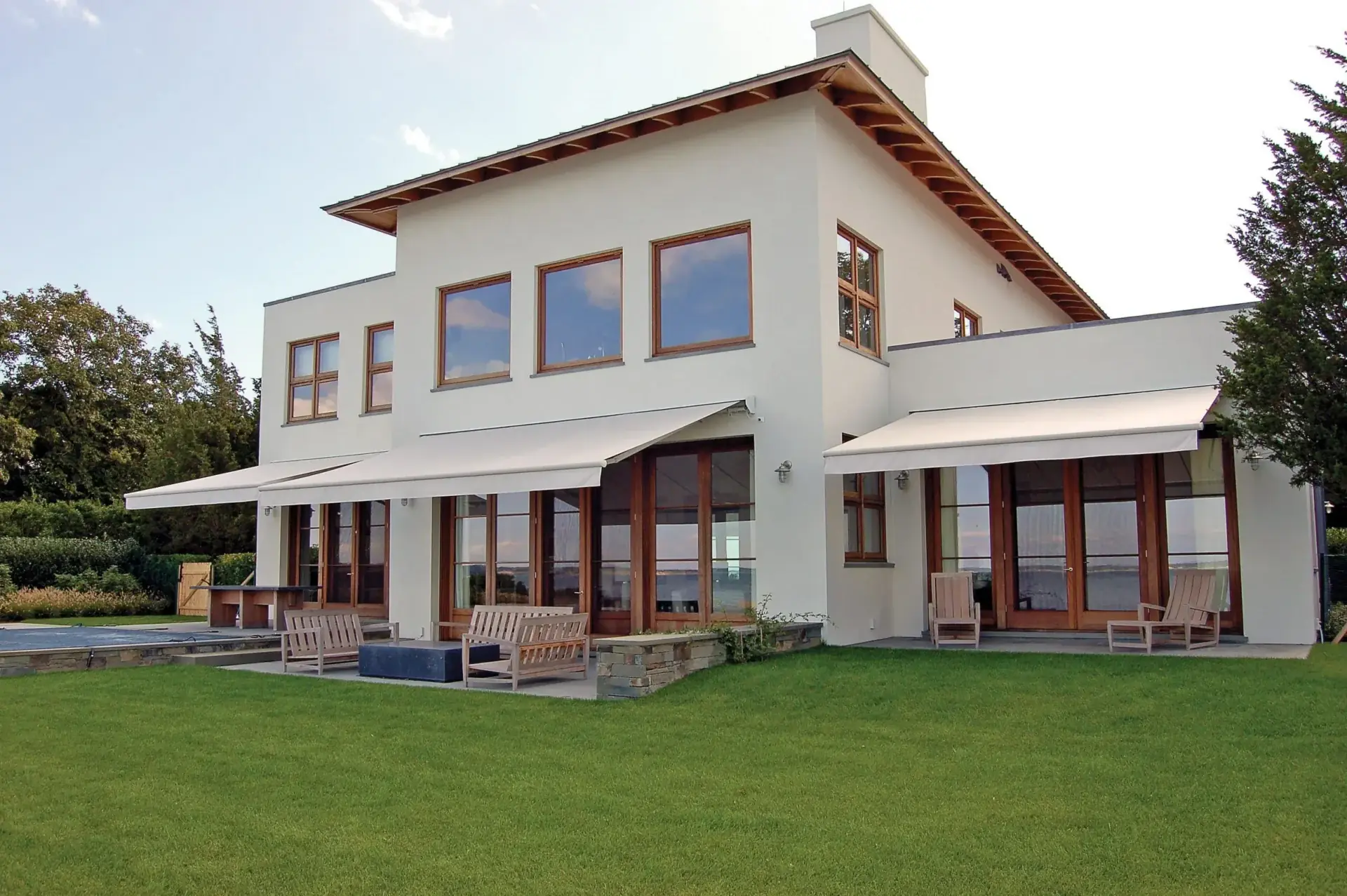
Exterior solar shades and retractable awnings
The only place to stop heat properly is outside the glass, before it's in the building. On the west face of Main Street an exterior solar shade or a retractable awning cuts the afternoon load in a way no interior fabric matches. National installed range is $1,000 to $6,000. Anchoring into masonry laid between 1880 and 1939 means the fixing points get checked before an order goes in, not after.
Commercial solar shades on the storefront
A full width display bay wants one clean roller on an outside mount, with a fascia closing the top and a center support bracket where the span calls for it. Openness gets picked by side of the street: 3 percent where the afternoon sun lands, 5 percent where it doesn't. The fabric controls glare on the goods without blacking out the window, which is the point of a storefront in the first place.
Wood blinds for the upper floors
The masonry reveals above the storefronts are the one place in Sheridan where a 2 inch wood blind sits fully inside the opening and looks intentional. Wand tilt keeps cords out of an office. On a round arched Romanesque head we set the blind at the springline and treat the arch above it as a separate fixed panel, which is cleaner than asking one unit to do both jobs.
Motorized and automated shades
Anything on the old opera house floor or above a storefront transom band is out of reach, and a manual chain at that height is a nuisance nobody uses twice. Motorized runs $300 to $1,500 per window installed nationally. Travel limits get set at commissioning. Battery life is about a year per Hunter Douglas, so on a permanent commercial install we'd rather hardwire and trickle charge than schedule an annual ladder.
Main Street between East 2nd and the old Monon line
The district runs along Main Street from East 2nd Street south to the Old Monon Railroad right of way, the physical trace of the line that arrived in 1882 and built the place. North Main and South Main carry the storefronts, and East 1st and East 2nd Streets cross them. The 1912 Carnegie library, the 1886 H.J. Thistlethwaite Building and the 1914 American State Bank building are the anchors, while Greek's Pizzeria and the Twin Kiss Drive-In are the addresses people actually give. The Monon Trail corridor follows the old right of way south toward Westfield. Sheridan Community Schools serves the district, its own corporation rather than Westfield Washington.
What the 2007 National Register listing controls on Main Street
On current evidence, nothing that touches window treatments. The district was listed on 20 September 2007 with 38 contributing buildings, and National Register listing by itself doesn't restrict a private owner spending private money. Indiana Landmarks states that owners can modify their historic properties as they wish unless federal or state money is involved. No Sheridan preservation commission with Certificate of Appropriateness authority was verified, so an awning over a Main Street storefront is a facade and signage question for the town rather than a preservation permit. The honest caveat: the town's own website wasn't successfully read during research, so treat that absence as unconfirmed and check with the town before anything goes on the exterior.
Window Treatment Services in Sheridan Downtown Commercial Historic District
Every service Sheridan Window Treatments offers across Sheridan is available to Sheridan Downtown Commercial Historic District homeowners.
Faux Wood Blinds in Sheridan Downtown Commercial Historic District
Moisture proof slats for Sheridan's baths and back kitchens
Learn more →Wood Blinds in Sheridan Downtown Commercial Historic District
Basswood for the 477 houses Sheridan built before 1940
Learn more →Vertical Blinds in Sheridan Downtown Commercial Historic District
Honest coverage for Sheridan's newest sliding doors
Learn more →Aluminum Mini Blinds in Sheridan Downtown Commercial Historic District
The shallow jamb fix for Sheridan's mid century openings
Learn more →Roller Shades in Sheridan Downtown Commercial Historic District
Clean fabric on a tube, with the gaps published upfront
Learn more →Solar Shades in Sheridan Downtown Commercial Historic District
Glare control sized to Sheridan's cardinal grid west sun
Learn more →Cellular Shades in Sheridan Downtown Commercial Historic District
The only shade with Department of Energy test numbers behind it
Learn more →Zebra Shades in Sheridan Downtown Commercial Historic District
One fabric, two settings, and no blackout promises
Learn more →Roman Shades in Sheridan Downtown Commercial Historic District
Soft folds for the tall openings of the 1866 plat
Learn more →Woven Wood Shades in Sheridan Downtown Commercial Historic District
Natural texture, with its variation disclosed first
Learn more →Blackout Shades in Sheridan Downtown Commercial Historic District
Dark rooms need channels, not just dark fabric
Learn more →Plantation Shutters in Sheridan Downtown Commercial Historic District
Rigid panels engineered for Sheridan's least rigid openings
Learn more →Cafe Shutters in Sheridan Downtown Commercial Historic District
Privacy at eye level on Sheridan's close set town lots
Learn more →Motorized Shades in Sheridan Downtown Commercial Historic District
Automation limited to the glass you can't reach
Learn more →Custom Drapery in Sheridan Downtown Commercial Historic District
Panels sized by fullness, hemmed after the fabric settles
Learn more →Valances & Top Treatments in Sheridan Downtown Commercial Historic District
Decoration sold as decoration, never as light control
Learn more →Exterior Solar Shades in Sheridan Downtown Commercial Historic District
Stop the heat outside the glass, then retract it
Learn more →Retractable Awnings in Sheridan Downtown Commercial Historic District
Shade for the patio, retracted before the weather
Learn more →Commercial Window Treatments in Sheridan Downtown Commercial Historic District
One elevation, one order, one dye lot
Learn more →Skylight Shades in Sheridan Downtown Commercial Historic District
Overhead glass covered, then reached without a ladder
Learn more →Sliding Glass Door Blinds in Sheridan Downtown Commercial Historic District
Stack parked off the panel you actually use
Learn more →Panel Track Blinds in Sheridan Downtown Commercial Historic District
Wide glass in flat panels, stacked to the side you choose
Learn more →Sheer Shades in Sheridan Downtown Commercial Historic District
Tilting fabric vanes that filter light without darkening a room
Learn more →Pleated Shades in Sheridan Downtown Commercial Historic District
The value shade, sold with its one real limitation stated
Learn more →Bamboo Shades in Sheridan Downtown Commercial Historic District
Natural weave, honest about how much light gets through
Learn more →Dual Shades in Sheridan Downtown Commercial Historic District
Two fabrics, one opening, and a level line required
Learn more →Top-Down Bottom-Up Shades in Sheridan Downtown Commercial Historic District
Light from the top, privacy down at the sidewalk
Learn more →Cordless Blinds in Sheridan Downtown Commercial Historic District
No hanging cord, and a spring that ages honestly
Learn more →Hardwood Shutters in Sheridan Downtown Commercial Historic District
Real wood where the trim is stained, and nowhere humid
Learn more →Composite Shutters in Sheridan Downtown Commercial Historic District
Heavier panels, engineered for Sheridan's widest openings
Learn more →Smart Home Shade Integration in Sheridan Downtown Commercial Historic District
Radio planning first, then shades, then the hub question
Learn more →Blind Repair & Restring in Sheridan Downtown Commercial Historic District
Fixed where it's fixable, said plainly when it isn't
Learn more →Shutter Repair in Sheridan Downtown Commercial Historic District
Hinges and louvers fixed, panel matching confirmed first
Learn more →Motorization Retrofit in Sheridan Downtown Commercial Historic District
Motors added to existing shades, where the headrail allows
Learn more →Outdoor Patio Shades in Sheridan Downtown Commercial Historic District
Anchored into structure, because wind is the failure mode
Learn more →Office Window Treatments in Sheridan Downtown Commercial Historic District
Glare, reach compliance and one specification per elevation
Learn more →Healthcare Window Treatments in Sheridan Downtown Commercial Historic District
Cleanable, cordless, and documented in the submittal package
Learn more →Multifamily Window Treatments in Sheridan Downtown Commercial Historic District
One specification per floor plan, ordered a phase at a time
Learn more →Communities Close to Sheridan
Sheridan Downtown Commercial Historic District is one of several Sheridan communities we serve. We measure and install across Sheridan, Hamilton County, and surrounding areas.
Sheridan Downtown Commercial Historic District Window Treatment FAQ
Questions we hear most often from Sheridan Downtown Commercial Historic District homeowners.
Free Assessment in Sheridan Downtown Commercial Historic District
Schedule a free, no-obligation window covering inspection. We respond promptly to all Sheridan Downtown Commercial Historic District inquiries.