Specialty Shape Windows Cost More. Here's Why, and What You Get
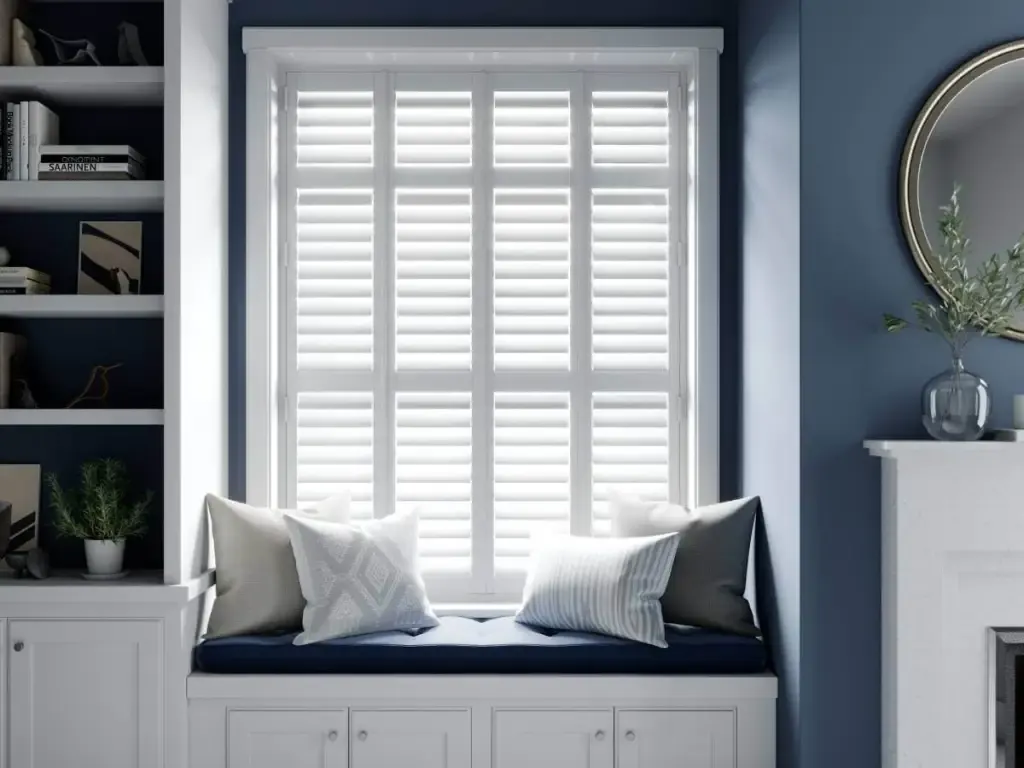
There's a reason specialty shape windows so often get left uncovered while the rest of the house gets finished: the standard catalog stops at rectangles and squares. Getting a shutter onto a curve or an angle is a real process, and it helps to know what that process involves before you start asking for quotes.
The Specialty Shapes We're Talking About
New construction in and around Sheridan throws a specific kind of specialty shape at homeowners more than any other: the gable end window. Builders love a trapezoid or a triangle tucked up into a high peak for curb appeal, and it looks great from the street. It also happens to be a shape that no standard shutter or blind was ever built to fit.
Beyond the gable trapezoid, you'll see true arch tops over garage-adjacent windows, half-round transoms above a front entry, and occasionally a full octagon used as an accent somewhere on the front elevation. Every builder-grade spec sheet stops at rectangles, so these shapes get handed to the homeowner as-is, usually bare, with the assumption that whoever moves in will figure it out eventually.
None of these shapes are actually unusual in the trade, even if they feel that way to a first-time homeowner staring up at one. A shop that's been doing this a while has almost certainly built for that exact shape before, just maybe not on that exact house.
Why Shutters Handle These Shapes Better Than Soft Treatments
Fabric and slat treatments both depend on a straight headrail or a rod to hang from, and a curved or angled opening doesn't give them one. That's the practical reason shutters dominate this category. A shutter is a rigid frame first, and the frame can be built to trace any shape the window actually is.
There are soft treatment workarounds for some shapes, mostly stationary fabric panels shirred onto a curved rod or mounted flat against the wall above the window, though they don't open or close. If the goal is actually controlling light through that section of glass, a shutter with a frame cut to the exact curve is usually the only option that does the job.
It also holds up better over time. A shaped fabric panel loses its form eventually, especially with humidity or direct sun on it, while a composite or wood shutter frame keeps its shape because it was built rigid from the start. That durability difference matters most on a window that sits in full sun most of the day.
Why a Tape Measure Isn't Enough for a Curve
A rectangle can be measured with a tape and a level and that's genuinely the whole job. A curve can't, because a tape only gives you straight-line distances, and no straight line actually describes an arc. You can capture the overall width and height that way, but the shape of the curve itself has to be captured differently.
What actually happens on site is a template: the real curve or angle gets traced onto stiff paper or cardboard held right against the opening, sometimes with a flexible tool for a tight radius, so the shop is cutting to the true shape instead of a calculated guess. Very few arches in an actual house turn out to be a perfect mathematical curve. Small shifts in the framing over the years mean the real shape and the theoretical shape rarely match exactly.
This is also where a DIY attempt carries real risk. A rectangular window forgives being off by an eighth of an inch. A curved one doesn't, since a panel that doesn't match the actual arc simply won't seat flush, and there's no sending back a custom-cut shaped shutter once it's built.
Cost, Lead Time, and What to Expect With a Specialty Order
Specialty shapes cost more than standard shutters, typically landing above the national 175 to 800 dollar per window range, and for a design-driven project the number worth focusing on is how the finished piece compares to leaving that window bare or mismatched, not just the raw dollar figure.
Lead time runs longer too, since the template, the design match check, and the custom build all take real time. For anyone timing this around an event, a listing photo shoot, or just wanting the house to look complete for a season, it's worth starting the process with enough runway.
Once it's in, though, a matched specialty shape tends to be the detail that finally makes a Sheridan home's front elevation look like it was designed as one piece rather than assembled window by window. That's usually the whole reason the project got started.
There's no way to quote a curved window off a description over the phone, and any number given that way isn't one to trust. Have someone come look at the actual shape, take a template, and walk you through what fixed and operable options exist for that specific window.
Fixed Panels vs Operable Louvers on the Shaped Section
This is where the real budget decision lives. Operable louvers on a shaped section cost meaningfully more than a fixed panel, because building hardware that tilts smoothly along a curve or an angle is a harder engineering problem than building a fixed frame to the same shape.
Here's the honest math worth doing before committing to operable: how often would you actually adjust that section. If it's positioned high, above a door or above the main window, the answer for most households is close to never. In that case, paying extra for tilt function on a section you won't reach anyway is money that could go toward the operable rectangle underneath instead, where the daily light control actually gets used.
Fixed isn't a downgrade. It's a deliberate way to put the budget where it does the most good, reserving the higher cost of operable hardware for the part of the window people actually interact with.
Frequently Asked Questions
Will a specialty shape shutter match the ones on my other windows?
It can, as long as the frame style, the finish, and the louver size are specified to match. The shaped section usually becomes part of the same order as the rest of the room's shutters so the whole wall reads as one system rather than a mismatched addition.
What if my window is a trapezoid instead of a curve?
Angled shapes like trapezoids and triangles get the same templating treatment as curves. The angles just need to be measured precisely at each corner rather than traced along a curve, and the shop builds the frame to match those exact angles.
Is there a cheaper alternative to a custom shaped shutter?
A stationary fabric-covered panel cut to the shape is sometimes offered as a lower-cost option, though it won't open or close. For most specialty shapes, the honest answer is that there isn't a stock or off-the-shelf option, since the whole problem is that the shape isn't standard.
 Do You Need Blackout, or Will Room Darkening Get the Job Done
 Inside Mount vs Outside Mount: Choosing the Right Fit for Your Sheridan Windows
 Battery or Hardwired: Powering Smart Shades in Sheridan