Do You Need Blackout, or Will Room Darkening Get the Job Done
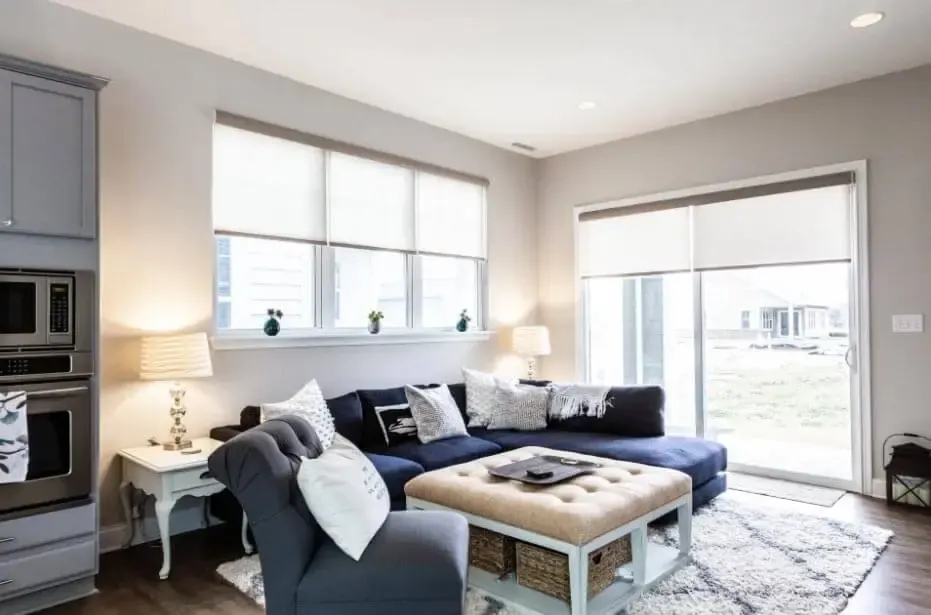
The words blackout and room darkening describe two genuinely different fabric constructions, not two marketing names for the same product, and the difference shows up in both performance and price.
What Blackout and Room Darkening Actually Mean
If better sleep is the reason you're looking at shades in the first place, it's worth understanding exactly what blackout and room darkening promise before picking one. Blackout fabric is engineered to block essentially all light passing directly through the material. Room darkening fabric blocks the large majority of it, typically in the 95 to 99 percent range, while letting a soft glow through.
That difference sounds small on paper and feels much bigger at 5am when the sun comes up. A room darkening shade in a west or east-facing bedroom will noticeably dim the room but won't erase that first hint of daylight the way a true blackout shade will.
The fabric spec is only part of the sleep equation, though. How the shade is mounted changes how much of that promised darkness you actually get once it's installed in your Sheridan bedroom.
Price Difference Between Blackout and Room Darkening
The construction difference between blackout and room darkening shows up directly in price. As a general national range, room darkening cellular or roller shades run $100 to $300 per window, and blackout versions of the same style typically run $130 to $380, roughly 15 to 25 percent more because of the extra lamination layer.
That gap is fairly consistent across shade styles, since it's driven by the fabric itself rather than by the lift mechanism or the headrail. A roller shade and a cellular shade in the same fabric grade will show a similar percentage jump from room darkening to blackout.
Matching the construction to the room, rather than choosing blackout across the board, is the most cost-effective way to apply what the fabric difference actually offers. A free in-home measure can price out both constructions for each window so the comparison is based on real numbers, not estimates.
A free in-home measure is a straightforward way to see both fabric options priced out for your actual rooms in Sheridan or IN communities, rather than guessing at which ones are worth the upgrade.
How Much Light Gets Through, Realistically
Here's a detail that affects value as much as it affects light control in a Sheridan home: even blackout fabric, mounted inside a window frame, leaves a small gap along the edges so the shade can operate without rubbing the frame. That gap is usually a quarter inch to half inch per side, and it lets some light through regardless of the fabric spec you paid for.
If total darkness is the actual goal, spending extra on blackout fabric while mounting inside the frame only gets you partway there. Outside mount, or a mount with side channels that block the edge gap, closes that light path more completely, and it's worth budgeting for that upgrade together with the fabric rather than fabric alone.
For a room where you just want things noticeably dimmer rather than fully dark, room darkening on a standard inside mount is often good enough, and it's the more budget-friendly choice for exactly that reason.
How the Fabric and Construction Differ
The construction difference is where the price and the performance both come from. Blackout fabric typically has three layers laminated together: the face fabric, a foam or acrylic middle layer, and a backing, sometimes with a fourth layer added for extra opacity. That lamination is what makes the material fully opaque even held up against a bright light.
Room darkening fabric usually skips one of those layers, often relying on a napped or foam-backed liner rather than full lamination. It's lighter and folds more compactly than blackout fabric, and that lighter build costs less to produce, which shows up directly in the price.
The heavier construction of blackout fabric has a side effect worth knowing about: it also blocks more outside noise and holds more heat than a lighter room darkening fabric would, for better or worse depending on the season and the room. It's a reasonable bonus in a bedroom and less of one in a sunroom you want warmed by the winter sun.
Which Rooms Call for Which Option
Another common mistake we see in Sheridan is choosing blackout for every room in the house on the assumption that darker is always better. In a kitchen or a dining room, blackout can make the space feel closed off during the day, and a home office is often no different.
Blackout earns its place in a primary bedroom or a nursery where nap time matters. It's worth the cost in a media room built for movie nights too. Outside of those rooms, room darkening or an even lighter light-filtering fabric usually fits daily life better.
Kids' rooms are worth a real conversation rather than a default choice, since some households want the total darkness of blackout for a toddler learning to nap, while others deliberately choose room darkening so there's enough glow to navigate the room at night.
Frequently Asked Questions
Why is there still light around the edges of my blackout shade?
That's normal for an inside-mounted shade. The fabric blocks light passing directly through it, but the shade still needs clearance along the sides to raise and lower without rubbing the frame, and light gets in through that gap regardless of the fabric grade.
Is room darkening good enough for a nursery?
Plenty of parents choose it on purpose, since it leaves enough ambient glow to check on a sleeping baby without turning on a light. Others prefer full blackout for nap time. It really comes down to what works for your household.
Does blackout fabric block heat and noise too?
It blocks a bit more of both than room darkening does, as a side effect of the heavier, multi-layer construction, though that isn't the main reason most people choose it.
 Inside Mount vs Outside Mount: Choosing the Right Fit for Your Sheridan Windows
 Battery or Hardwired: Powering Smart Shades in Sheridan
 A Sheridan Homeowner's Guide to Custom Drapery for 2008